Stearic Acid
Also known as: Octadecanoic acid
A waxy fatty acid used to shape creams and cleansers, not an exfoliating acid or a proven standalone skin treatment.
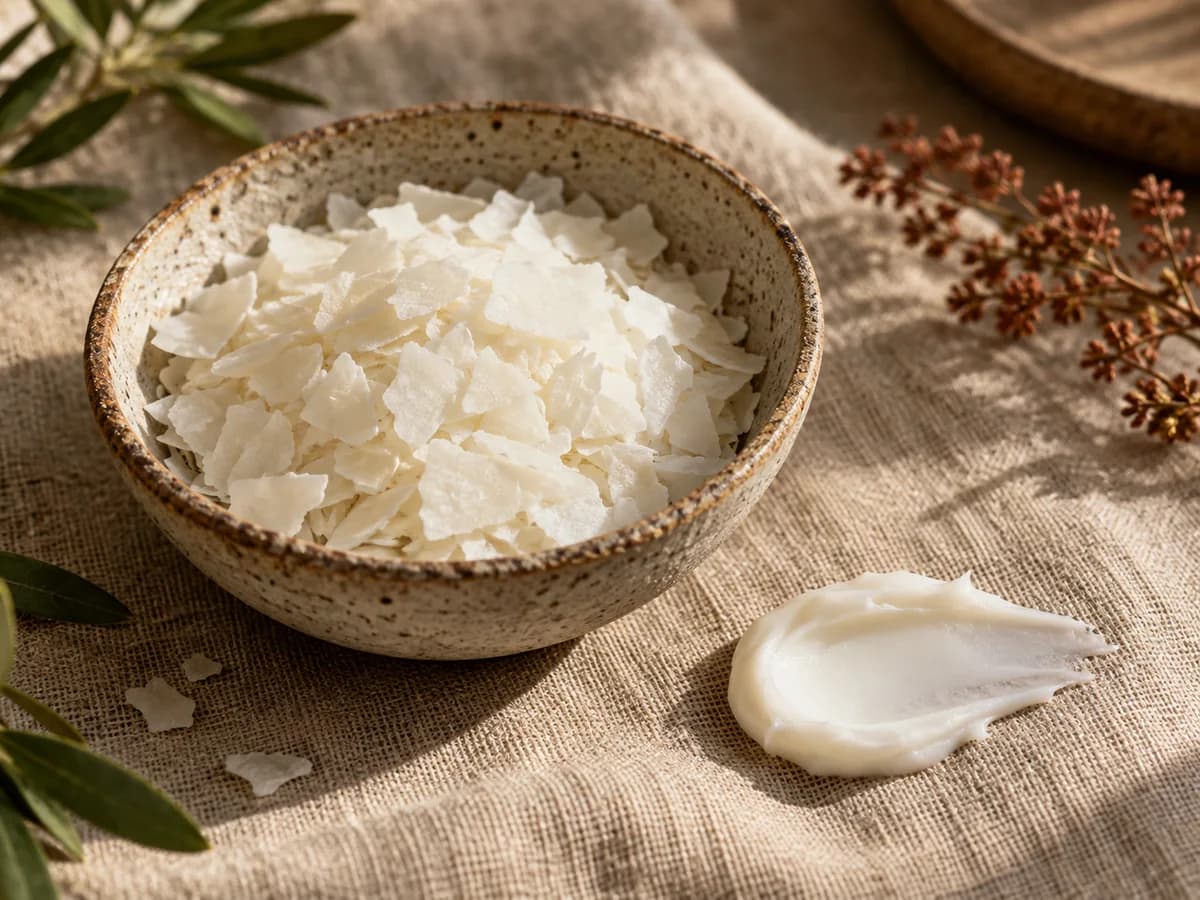
Stearic acid is a saturated fatty acid used in cosmetic formulations, including creams and soaps. Its name does not make it an exfoliating acid like glycolic or salicylic acid. The useful distinction is between an ingredient's role in a formula and evidence that the finished product improves a skin condition.1, 2
- A saturated C18 fatty acid, not an AHA or BHA exfoliant.1
- Raw stearic acid and its stearate salts are related but distinct ingredients.1
- Lipid-mixture experiments do not establish a benefit from stearic acid alone.2
What is Stearic Acid?
Stearic acid has an 18-carbon chain and a waxy character. Manufacturers obtain and purify fatty acids from fat or oil feedstocks; the label alone does not establish whether a particular supply is plant-derived or animal-derived. Neutralization can produce stearate salts, so a soap's chemistry is not identical to leaving raw stearic acid on the skin.1
Where it comes from
Natural sources
- Fatty acids obtained from plant oils or animal fats
How it's made
Commercial material is processed and purified; feedstock and supplier documentation determine its origin.
What it does in products
Benefits
Texture and formulation performance
limited evidenceStearic acid contributes to how a cosmetic is made and feels. That is a formulation function, not proof of an acne, wrinkle or eczema treatment.1
CIR describes ingredient functions and cosmetic exposure. Its safety assessment is not a comparative clinical trial of consumer skin outcomes.
Standalone barrier-repair claims
insufficient evidenceResearch on mixtures of cholesterol, ceramides and fatty acids cannot identify stearic acid alone as the reason a product works.2
The 1996 experiments were primarily in mice, with preliminary human work. Lipid ratios and complete mixtures were tested, not a universal stearic-acid serum.
Evidence scope and limitations
Topical stearic acid in finished cosmetics and distinctions from salts, exfoliants and multi-lipid barrier formulations; not dietary saturated-fat advice.
- A group safety assessment does not establish clinical efficacy of an individual cosmetic.
- The lipid-mixture source is largely experimental and does not isolate stearic acid as a treatment.
Evidence last checked: 2026-10-07
Side effects & safety
Safety considerations
- These sources do not establish compatibility of every finished product with prescription skincare.
- Not for: Avoid a formula known to trigger your contact allergy; discontinue persistent irritation and seek assessment for a significant reaction.
Amounts studied & product use
These figures describe research or common product use, not a personal dose or treatment recommendation.
In skincare studies and products
CIR reported stearic acid use up to 37.4% in rinse-off bath soaps/detergents and 21% in leave-on eyebrow pencils. Those survey maxima describe particular product categories, not a recommended face-cream percentage or DIY dose.
Regulatory status
- Cosmetics are FDA-regulated but generally are not preapproved by FDA. Stearic acid on a cosmetic label is not an FDA-approved treatment claim.
- INCI name on cosmetic labels: Stearic Acid.
- The 2019 final fatty-acid group assessment concluded safety under the reported uses and concentrations when formulated to be nonirritating and nonsensitizing.
Why an ingredient-name pore score is not enough
A binary 'clogs pores' score leaves out the rest of the formula, how much is used and whether it is rinsed off. None of the cited sources supplies a universal clinical acne-risk ranking for all products containing stearic acid.
Our reading: a safety assessment can help evaluate exposure, but it cannot stand in for a finished-product acne trial. Likewise, a barrier experiment with several lipids should remain a claim about that mixture.
1, 2Frequently asked questions
Does stearic acid exfoliate like glycolic acid?
No. Its fatty-acid chemistry and formulation roles are different. The word acid is not a useful shortcut for deciding whether a cosmetic is a peel.1
Can a stearic-acid label prove a product is vegan?
No. The ingredient name does not identify the feedstock used for that supply. A product-specific sourcing statement is needed.1
The bottom line
Read stearic acid as part of the whole formula. Neither an acid name nor a safety report establishes a treatment benefit.
References
- Safety Assessment of Fatty Acids & Fatty Acid Salts as Used in Cosmetics. Cosmetic Ingredient Review (2019) · safety assessment · Final report released May 15, 2019
- Man MQ, Feingold KR, Thornfeldt CR, Elias PM. Optimization of physiological lipid mixtures for barrier repair. Journal of Investigative Dermatology (1996) · primary study · PMID 8618046; DOI 10.1111/1523-1747.ep12340135
- Allergens in Cosmetics. U.S. Food and Drug Administration · government guidance · Undated resource; accessed October 7, 2026
- FDA Authority Over Cosmetics: How Cosmetics Are Not FDA-Approved, but Are FDA-Regulated. U.S. Food and Drug Administration (2013) · government guidance
Revision history
- Initial AI-assisted source compilation with claim-level citations, formulation distinctions and explicit evidence limitations; not independent medical review.