Titanium Dioxide
Also known as: TiO2, Titania, CI 77891
A mineral UV filter and white pigment whose safety context changes sharply between intact-skin use and inhalable powder.
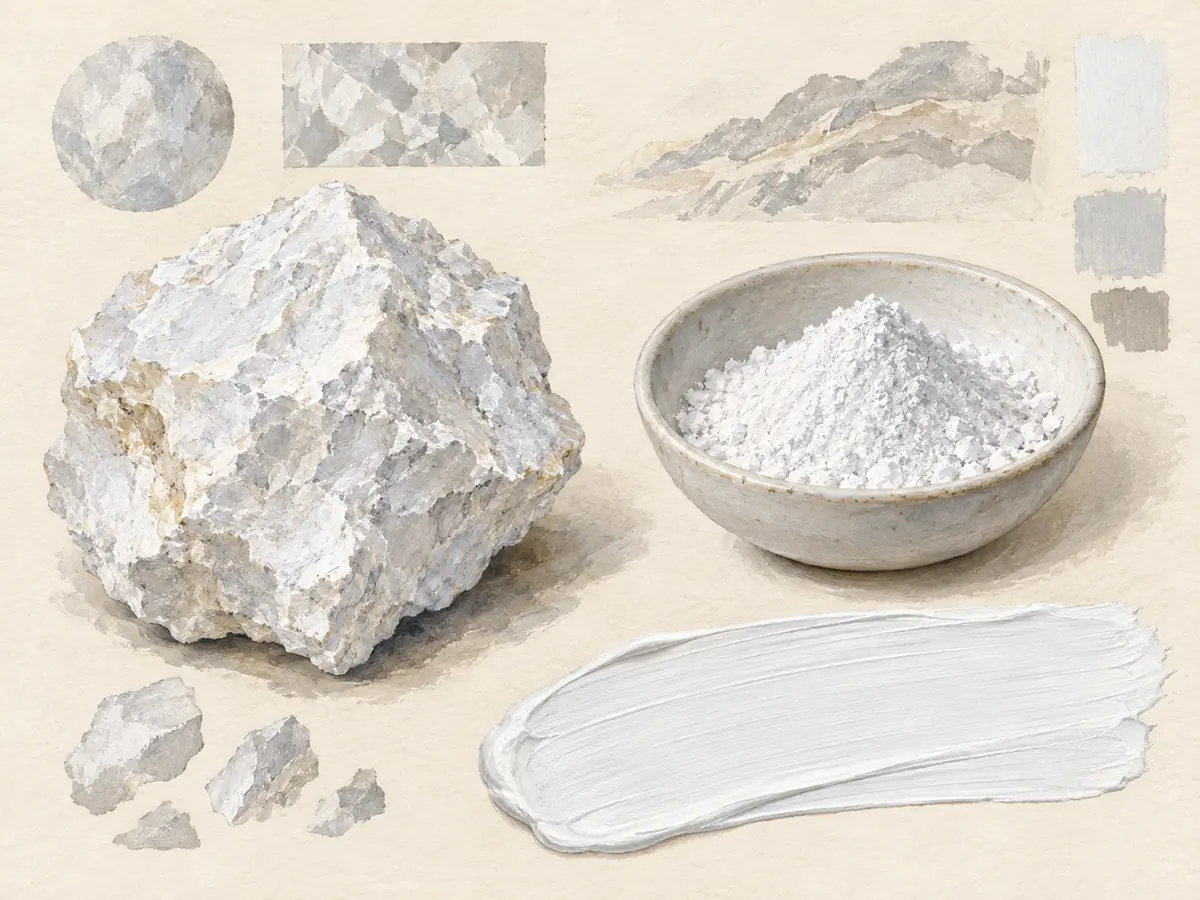
Titanium dioxide is an inorganic mineral used as a UV filter in sunscreen and as a white pigment or opacifier. FDA's sunscreen framework permits it up to 25%, and current evidence indicates little penetration through intact skin. That topical assessment should not be generalized to inhalation of loose or sprayable particles.2, 3, 4
- Mineral sunscreen active and white pigment1, 2
- Reflects and absorbs ultraviolet radiation1, 2
- Permitted in U.S. OTC sunscreen up to 25%1, 2
- Inhalation exposure is distinct from cream use1, 2
What is Titanium Dioxide?
Titanium dioxide occurs in mineral forms such as rutile and anatase. Cosmetic particles are processed for optical performance and may be coated to improve dispersion and reduce unwanted reactivity.1, 2
Where it comes from
Natural sources
- Titanium-bearing mineral ores
How it's made
Cosmetic and sunscreen grades are purified, milled, crystal-controlled, and often surface-coated.
What it does in products
Benefits
Ultraviolet protection
strong evidenceLow intact-skin penetration
moderate evidenceUniversal protection from visible light
insufficient evidenceOrdinary un-tinted titanium dioxide does not guarantee meaningful visible-light protection for hyperpigmentation.2
Visible-light performance depends on particle size, pigment dispersion, tint, and iron oxides in the finished product.
Evidence scope and limitations
Topical sunscreen and pigment use on skin are separated from occupational, food, and inhalation exposure.
- Finished-product UV performance cannot be inferred from ingredient percentage alone.
- Particle coating and aerosol behavior vary by product.
Evidence last checked: 2026-09-28
Side effects & safety
Safety considerations
- No drug interactions expected from topical sunscreen use
- Not for: Deliberate inhalation of loose powder or aerosol
- Not for: Relying on raw pigment instead of a tested sunscreen
Amounts studied & product use
These figures describe research or common product use, not a personal dose or treatment recommendation.
In skincare studies and products
FDA OTC sunscreen monograph M020 lists titanium dioxide up to 25%. The protective value comes from a tested finished product, not from mixing pigment into skincare at home.
Regulatory status
- Listed in U.S. OTC sunscreen monograph M020 up to 25%; also used as a cosmetic colorant and opacifier under applicable rules.
- INCI name on cosmetic labels: Titanium Dioxide.
Nano is a size description, not a complete risk conclusion
Particle size affects transparency and UV behavior. Safety evaluation also considers coating, aggregation, route, dose, and whether particles are inhaled or applied in a cream. A single nano label cannot answer all of those questions.
4, 3Frequently asked questions
Is titanium dioxide a chemical or mineral sunscreen?
It is commonly called a mineral or inorganic UV filter; all ingredients are chemicals in the broader scientific sense.2, 3, 4
The bottom line
Titanium dioxide has strong topical sunscreen utility; aerosol and DIY powder exposure should not borrow the safety conclusions of tested creams.
References
- Titanium dioxide: compound summary. PubChem, National Library of Medicine (2026) · ingredient monograph · CID 26042
- OTC Monograph M020: Sunscreen Drug Products for Over-the-Counter Human Use. U.S. Food and Drug Administration (2021) · government guidance · OTC Monograph M020
- Questions and Answers: FDA regulatory actions on over-the-counter sunscreen. U.S. Food and Drug Administration (2026) · government guidance
- Human safety review of nano titanium dioxide and zinc oxide. Photochemical & Photobiological Sciences (2010) · other · PMID 20354643
Revision history
- Initial publication with claim-level citations, formulation limits, safety context, and editorial evidence review.