Sucralose
Also known as: E955, Sucralose sweetener
A high-intensity sweetener; authorized-use safety, prolonged heating and long-term weight-control evidence are separate questions.
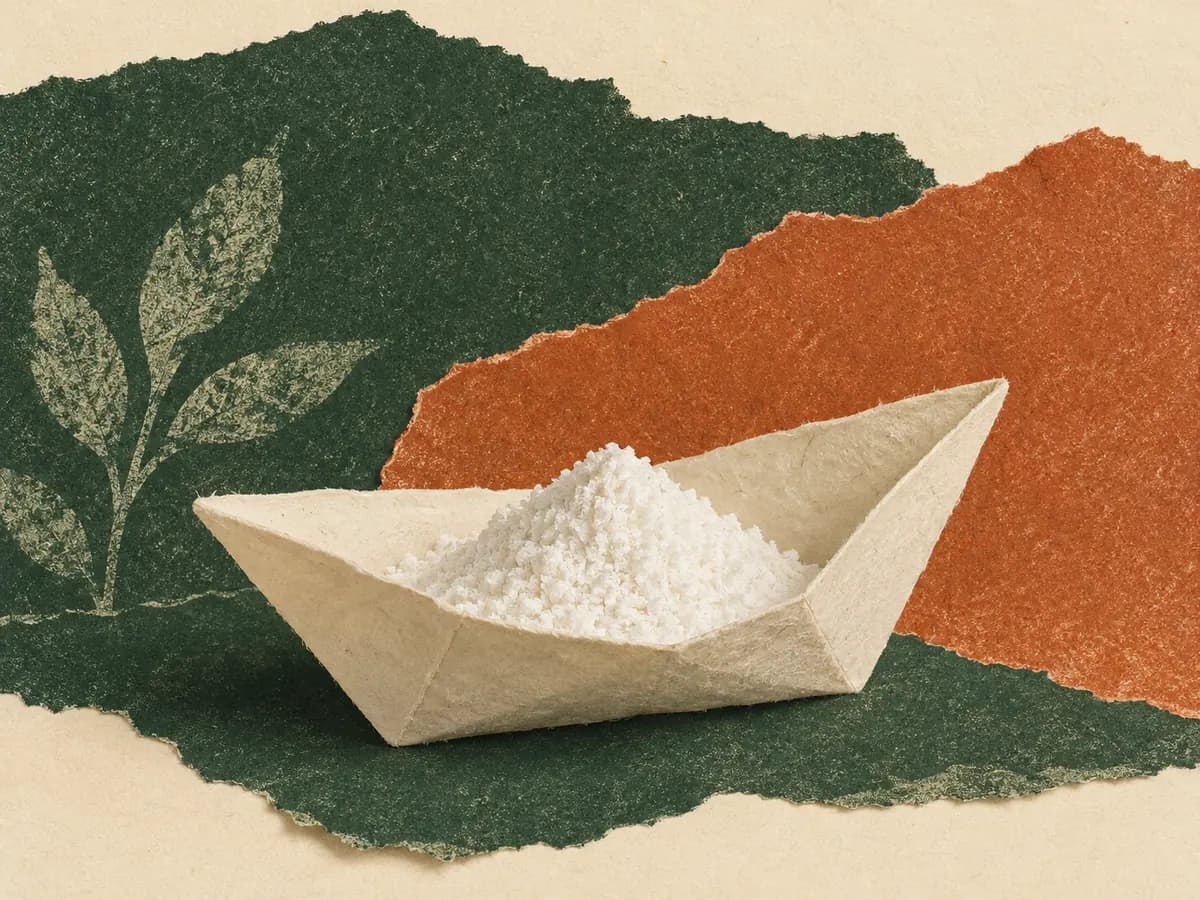
Sucralose is a manufactured high-intensity sweetener, about 600 times sweeter than sucrose. It is permitted in U.S. foods under defined conditions. EFSA's 2026 review supported currently authorized uses but could not clear a proposed wider baking use. Safety at assessed exposure does not establish a lasting weight-loss benefit.1, 2, 3, 4
- FDA's ADI is 5 mg/kg body weight/day; EFSA retained 15 mg/kg/day in 2026.1, 3
- An ADI is a safety benchmark, not a target consumption amount or weight-loss dose.1, 4
- The Suez trial tested four sweeteners across 120 adults for two weeks, not 120 sucralose users.5, 3
What is Sucralose?
The U.S. rule specifies the chemical and food-grade requirements, rather than a particular branded packet. Small amounts provide sweetness, while a packet or finished food can contain other ingredients. Assess the complete formula and whether sugar is actually replaced, not just the presence of the word sucralose.2, 3, 1
Where it comes from
Natural sources
- No botanical or naturally harvested source is claimed for this specified food additive.
How it's made
A manufactured, specified sweetening compound; E955 is its food-additive designation, not a botanical extract.
What it does in products
Benefits
Sweetness is not demonstrated long-term weight control
insufficient evidenceUsing a small quantity as a sweetener is a technical function. It does not by itself show that a person or finished product will improve long-term health.4, 1
WHO conditionally advises against non-sugar sweeteners for weight control in people without pre-existing diabetes. That class-level recommendation is not a sucralose-specific poisoning conclusion, nor an update of an agency's ADI.
Evidence scope and limitations
Sucralose in U.S. foods, the final 2026 EFSA assessment, WHO's class-level recommendation and one short human trial; not every finished formula or health outcome.
- An authorized-use safety conclusion is not a weight-loss efficacy trial.
- The small Suez groups and two-week duration do not establish long-term disease incidence.
- The original trial's primary abstract and EFSA's dose table were checked; unseen full-text details are not asserted.
- The proposed bakery extension and current authorized uses are distinct exposure scenarios.
Evidence last checked: 2026-10-12
Side effects & safety
Safety considerations
- The sweetener studies are not a comprehensive medicine-interaction assessment. The WHO weight-control recommendation excludes pre-existing diabetes and should not replace an individual diabetes-care plan.
- Not for: Do not infer that unlimited consumption or every heating process is cleared by an authorized-use assessment.
- Not for: Prolonged high-temperature baking or frying raises unresolved degradation-product questions in the 2026 EFSA assessment; sweetness remaining after heating is not the same as demonstrating chemical safety.
Amounts studied & product use
These figures describe research or common product use, not a personal dose or treatment recommendation.
In supplement studies and products
Sucralose is a food sweetener, not a supplement dose. EFSA tabulates the Suez study at 102 mg/day in commercial sachets for two weeks, with glucose-vehicle controls. That exposure and the differing U.S./EU ADIs are research and safety contexts, not personal intake instructions. Count sucralose content, not packet mass.
Regulatory status
- 21 CFR 172.831 permits the specified food-grade additive as a general food sweetener under current good manufacturing practice, no more than reasonably needed for its effect. FDA and EFSA use different safety benchmarks. EFSA's 2026 uncertainty about extending baking uses is not a U.S. prohibition or withdrawal of its existing authorized-use conclusion.
Compare the question before comparing the headline
WHO asks whether non-sugar sweeteners are a useful long-term weight-control strategy; FDA and EFSA assess allowable exposure. The Suez experiment measured short-term responses, with person-specific effects and a mouse-transfer component that must not be presented as a human disease outcome.
Our reading: do not select one adverse signal while hiding the broader assessment, and do not turn that broader assessment into a claim that every recipe or lifestyle outcome has been tested. Toxicology, heated-food chemistry and sustained dietary behavior require different evidence.
4, 3, 5, 1Frequently asked questions
Does a heat-stable sweet taste prove every baking process is safe?
No. EFSA retained its current-use safety conclusion but identified uncertainty about unwanted compounds under prolonged high-temperature conditions and a proposed extension in bakery products.3
Is the WHO recommendation an announcement that sucralose is toxic?
No. It is conditional, concerns weight control and disease-risk strategy, excludes pre-existing diabetes, and does not replace individual-sweetener toxicology assessments.4
The bottom line
Separate the food's formulation, exposure benchmark and dietary goal; none can be answered from sweetness or an isolated study headline alone.
References
- Aspartame and Other Sweeteners in Food. U.S. Food and Drug Administration · government guidance · Undated agency resource; sucralose section and ADI table checked October 12, 2026
- 21 CFR 172.831: Sucralose. Electronic Code of Federal Regulations · government guidance · Current section checked October 12, 2026; continuously maintained rule, not a 2026 publication
- EFSA Panel on Food Additives and Flavourings. Re-evaluation of sucralose (E 955) as a food additive and evaluation of a new application on extension of use of sucralose (E 955) in fine bakery wares. EFSA Journal (2026) · safety assessment · DOI 10.2903/j.efsa.2026.9854; final scientific opinion, 2026
- WHO advises not to use non-sugar sweeteners for weight control in newly released guideline. World Health Organization (2023) · clinical guideline · May 15, 2023; official guideline summary; recommendation conditional, not a toxicology reassessment
- Personalized microbiome-driven effects of non-nutritive sweeteners on human glucose tolerance. Cell (2022) · randomized trial · PMID 35987213; DOI 10.1016/j.cell.2022.07.016; primary abstract plus EFSA trial table checked
Revision history
- Initial AI-assisted source checks and claim-level citation mapping under the site-authorized publishing workflow. No separate human or independent medical review is claimed.