Pullulan
Also known as: E1204, Pullulan film former
A fermentation-derived film former used in cosmetics and capsule shells; safety assessments do not establish wrinkle treatment or fibre efficacy.
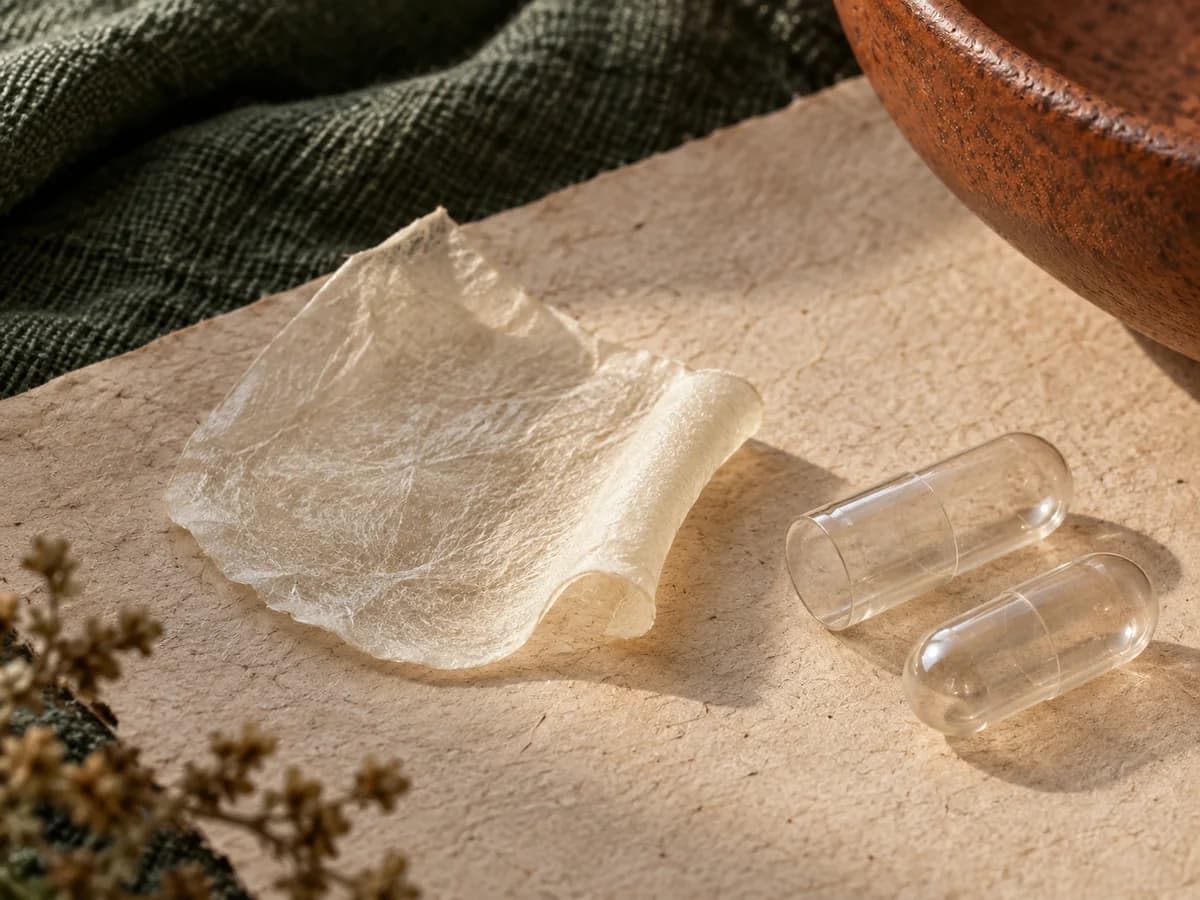
Pullulan is a fermentation-derived polysaccharide used as a cosmetic binder and film former and in some edible films and capsule shells. CIR and food-safety assessments address defined uses, not proof of lasting wrinkle correction, superior supplement absorption or a clinical fibre benefit. No numerical acceptable daily intake does not mean unlimited intake.1, 2, 3
- CIR lists unmodified pullulan's cosmetic functions as binder and film former.1
- The 2025 EFSA opinion reports possible mild gastrointestinal effects at around 10 g/day and above.2
- JECFA explicitly assessed safety of use, not pullulan's efficacy as dietary fibre.3
What is Pullulan?
Food-grade starch is fermented with Aureobasidium pullulans, then the resulting polymer is purified. The finished ingredient is not a live probiotic. Myristoyl pullulan and other chemically modified materials are separately named ingredients, not automatic equivalents of unmodified pullulan.2, 1
Where it comes from
Natural sources
- Polysaccharide produced through microbial fermentation
How it's made
Commercial material is recovered and purified from fermentation. Its identity and specifications differ from the producing organism or a modified derivative.
What it does in products
Benefits
Film formation rather than a demonstrated medical effect
limited evidencePullulan's documented formulation role does not by itself show lasting structural skin change or improved clinical outcomes from an encapsulated ingredient.1, 2, 4
The final CIR report concerns cosmetic safety and reported functions. EFSA evaluates food exposure. Neither is a randomized wrinkle-treatment or capsule-bioavailability trial; a finished formula's claimed performance needs separate evidence.
Evidence scope and limitations
Unmodified pullulan in reported cosmetic uses, capsule/film food uses and the 2025 food-safety re-evaluation; not every derivative or a therapeutic efficacy review.
- CIR's group safety assessment is not a pullulan-only clinical efficacy trial.
- Oral tolerability studies cannot supply a topical irritation rate or a personal beneficial dose.
- A no-numerical-ADI conclusion retains material specifications and use assumptions.
- The cited sources do not establish lasting wrinkle correction, improved capsule bioavailability or fibre-treatment efficacy.
Evidence last checked: 2026-10-11
Side effects & safety
Safety considerations
- The cited safety assessments do not establish equivalent drug release or absorption from every pullulan capsule; formulation-specific performance remains a separate question.
- Not for: Do not interpret no numerical ADI as permission to take unrestricted polymer amounts; assessed identity, purity and intended use still matter.
- Not for: Food-use evidence is not permission to ingest a finished cosmetic or use an uncharacterized fermentation material.
Amounts studied & product use
These figures describe research or common product use, not a personal dose or treatment recommendation.
In supplement studies and products
EFSA discusses mild gastrointestinal effects from oral amounts around 10 g/day and above; this is tolerability evidence, not a beneficial fibre dose or a universal cutoff for every person. Capsule-shell and edible-film exposure should not be confused with intentionally taking a gram-dose fibre product.
In skincare studies and products
The CIR conclusion covers reported cosmetic practices and concentrations, not a universal optimal percentage or DIY recipe. Use conditions are formula-specific.
Regulatory status
- The cited EFSA and JECFA food assessments are not U.S. authorization for every use or a therapeutic claim. FDA distinguishes cosmetic appearance claims from disease-treatment claims by intended use.
- INCI name on cosmetic labels: Pullulan.
- The published 2016 final microbial-polysaccharide-gum assessment includes pullulan and concludes the group is safe in the described cosmetic practices and concentrations; this is a use-specific safety conclusion, not FDA efficacy approval.
No numerical ADI is not an unlimited-use claim
JECFA retained an ADI described as not specified while emphasizing gastrointestinal effects and appropriate use levels. It also explicitly separated food safety from fibre efficacy. The wording cannot be shortened to take as much as you want.
Our reading: separate the function of the shell from the contents of a capsule, and a film's formulation role from a clinical skin outcome. A safe material can have a useful technical role without being an active treatment; food and cosmetic assessments answer different exposure questions.
3, 2, 1, 4Frequently asked questions
Is fermentation-derived pullulan a live probiotic?
No. The described production process removes microbial cells and purifies the polymer. Origin by fermentation does not make the finished film former a living culture.2
The bottom line
Treat pullulan as a specified film-forming material; assess shell performance, clinical claims and exposure safety independently.
References
- Fiume MM, Heldreth B, Bergfeld WF, Belsito DV, Hill RA, Klaassen CD, Liebler DC, Marks JG Jr, Shank RC, Slaga TJ, Snyder PW, Andersen FA. Safety Assessment of Microbial Polysaccharide Gums as Used in Cosmetics. International Journal of Toxicology / Cosmetic Ingredient Review (2016) · safety assessment · DOI 10.1177/1091581816651606; published final assessment, not a Do Not Cite draft
- EFSA Panel on Food Additives and Flavourings. Re-evaluation of pullulan (E 1204) as a food additive and new application for its extension of use. EFSA Journal (2025) · safety assessment · DOI 10.2903/j.efsa.2025.9267; published March 12, 2025
- Pullulan: JECFA evaluation. World Health Organization / Joint FAO/WHO Expert Committee on Food Additives (2011) · safety assessment · INS 1204; 74th meeting; TRS 966; food safety, not fibre efficacy
- Is It a Cosmetic, a Drug, or Both? (Or Is It Soap?). U.S. Food and Drug Administration · government guidance · Intended-use classification guidance; accessed October 11, 2026
Revision history
- Initial AI-assisted source checks and claim-level citation mapping under the site-authorized publishing workflow. No separate human or independent medical review is claimed.