Polyglutamic Acid
Also known as: Poly-γ-glutamic acid, Gamma-PGA, γ-PGA, Polyglutamate
A fermentation-derived water-binding polymer with promising formulation data but little direct human clinical evidence.
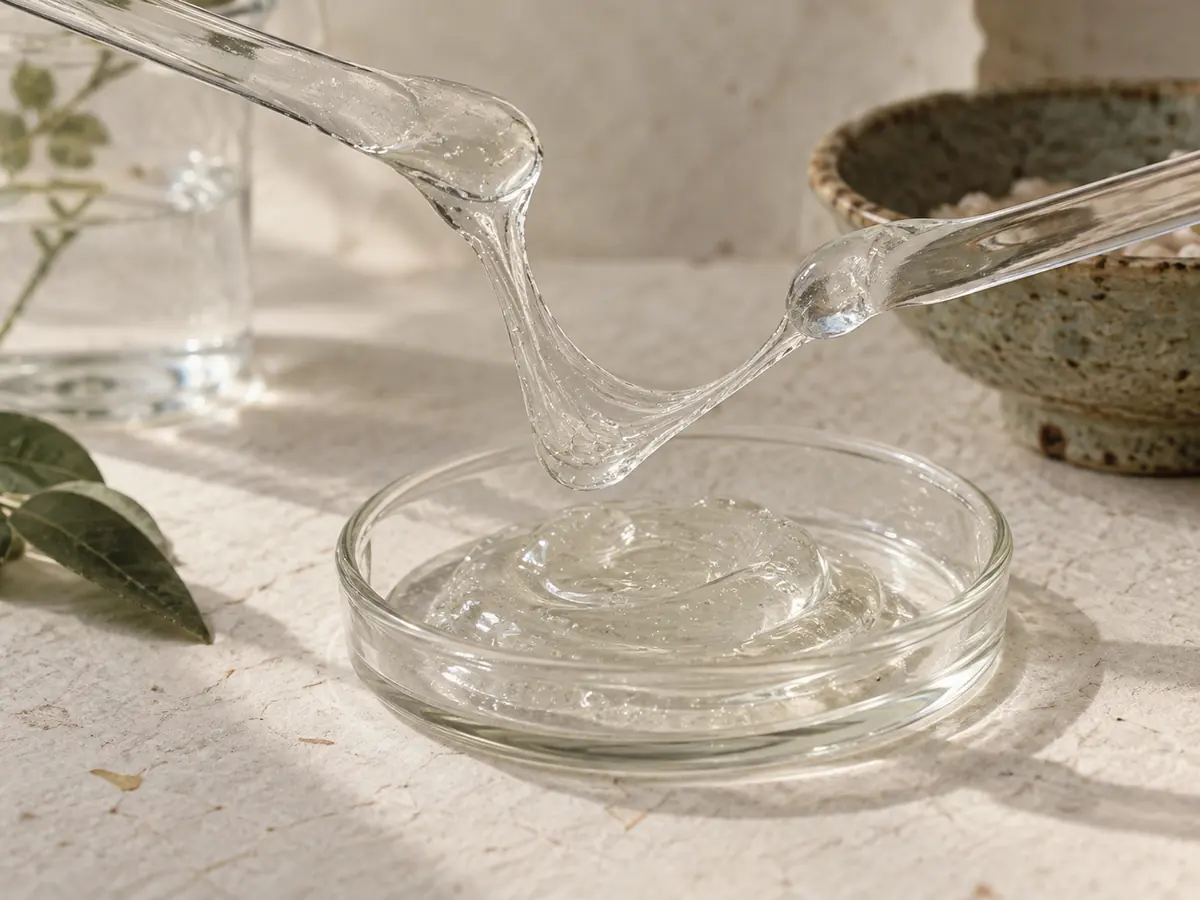
Polyglutamic acid is a biodegradable polymer made from linked glutamic-acid units, commonly produced by Bacillus fermentation. In skincare it acts mainly as a film-forming humectant. Laboratory and reconstructed-skin work supports water retention, but marketing comparisons with hyaluronic acid exceed the available head-to-head human evidence.1, 2, 3
- Usually produced by microbial fermentation1, 3
- Functions as a humectant and film former1, 3
- Molecular size limits how deeply it penetrates1, 3
- Human comparative trials remain sparse1, 3
What is Polyglutamic Acid?
Polyglutamic acid is not the same molecule as free glutamic acid. It is a high-molecular-weight, water-soluble polymer whose chain length, salt form, and formulation determine texture and water binding.1, 3
Where it comes from
Natural sources
- Bacterial fermentation, especially Bacillus species
- Natto-like fermented materials
How it's made
Cosmetic-grade material is purified after controlled fermentation and may be supplied as polyglutamate salts or solutions.
What it does in products
Benefits
Surface hydration
limited evidenceBarrier support
limited evidenceNew model work reports changes consistent with moisture retention and barrier support.1
A keratinocyte or reconstructed-skin result cannot establish a clinical outcome on its own.
Evidence scope and limitations
Topical cosmetic poly-γ-glutamic acid is evaluated as a polymer and formulation material, not as oral glutamate or an exfoliating acid.
- Most evidence is preclinical or formulation-focused.
- Polymer size, salt form, and finished-product vehicle vary.
Evidence last checked: 2026-09-28
Side effects & safety
Safety considerations
- No established drug interactions from topical cosmetic use
- Not for: Known allergy to the finished product
Amounts studied & product use
These figures describe research or common product use, not a personal dose or treatment recommendation.
In skincare studies and products
Commercial formulas use varying polymer grades and concentrations; published model studies do not establish a universal percentage. Evaluate the complete formula rather than treating a higher percentage as automatically better.
Regulatory status
- Used as a cosmetic ingredient in the United States; cosmetic products are not FDA pre-approved for hydration or anti-aging claims.
- INCI name on cosmetic labels: Polyglutamic Acid.
A polymer, not an exfoliating acid
Despite the word acid, polyglutamic acid is not used like glycolic or salicylic acid. It does not belong in an exfoliation schedule; its role is primarily water management and film formation at the skin surface.
1, 3Frequently asked questions
Can polyglutamic acid be layered with hyaluronic acid?
They can coexist in a formula or routine, but adding more humectant layers is not always more comfortable in every climate or vehicle.1, 2, 3
The bottom line
Polyglutamic acid is best understood as a film-forming humectant with promising bench evidence, not a proven replacement for every other hydrator.
References
- Poly-γ-Glutamic Acid from a Novel Bacillus subtilis Strain: Strengthening the Skin Barrier and Improving Moisture Retention in Keratinocytes and a Reconstructed Skin Model. International Journal of Molecular Sciences (2025) · primary study · PMID 39940752
- Brown algae as a valuable substrate for the cost-effective production of poly-γ-glutamic acid for applications in cream formulations. Polymers (2024) · primary study · PMID 39065408
- Polyglutamic acid ingredient record and safety documents. Cosmetic Ingredient Review (2026) · safety assessment
- FDA Authority Over Cosmetics: How Cosmetics Are Not FDA-Approved, but Are FDA-Regulated. U.S. Food and Drug Administration (2013) · government guidance
Revision history
- Initial publication with claim-level citations, formulation limits, safety context, and editorial evidence review.