Honey (Skincare)
Also known as: Mel, Honey, Manuka honey
A sugar-rich skincare material whose wound-dressing evidence should not be transferred to kitchen honey or a rinse-off mask.
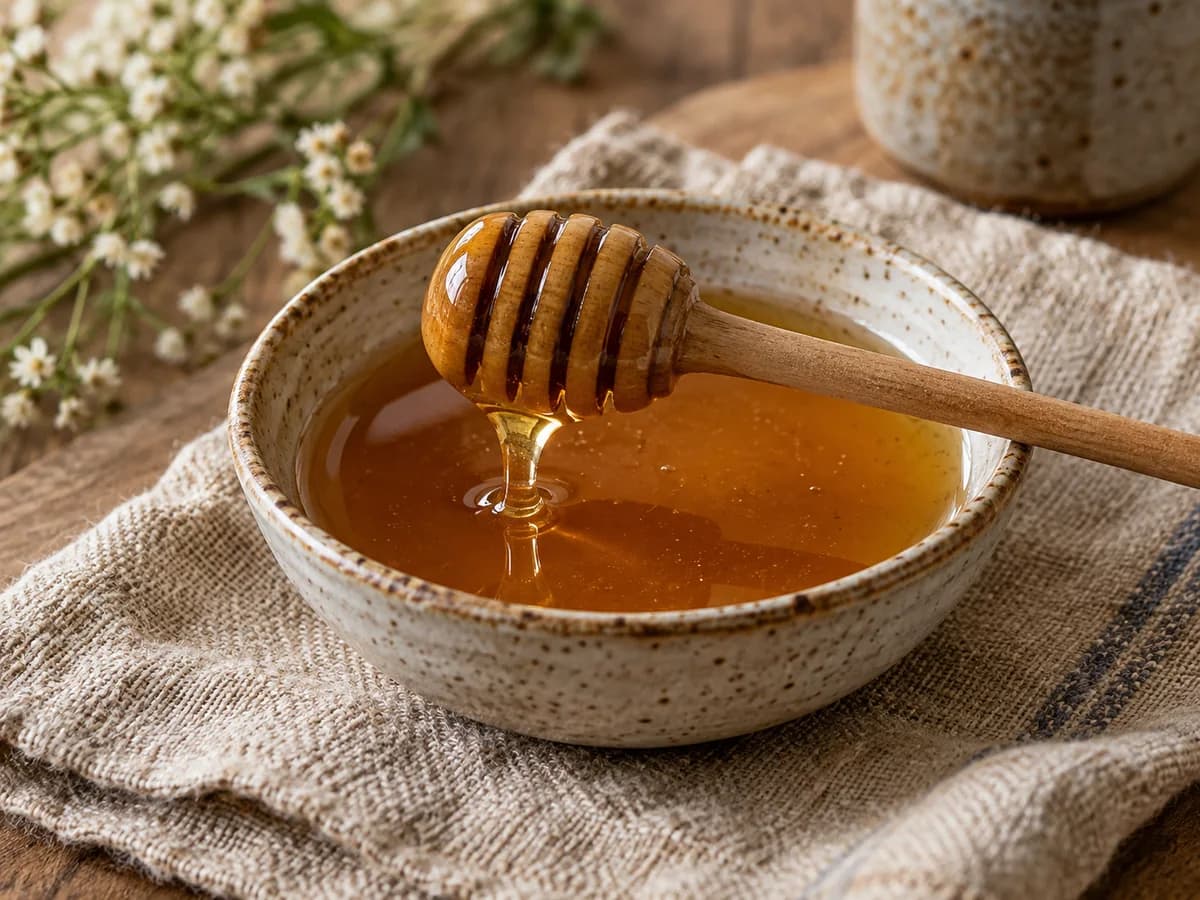
Honey is a sugar-rich material used in some skincare products. Research on honey dressings suggests benefits for certain wound comparisons, but the results vary widely by wound type. That evidence does not prove that a honey face mask treats acne, or that kitchen honey is a suitable substitute for regulated wound care.1, 2
- Honey is largely a concentrated sugar solution.1
- The 2015 Cochrane review covered 26 trials and 3,011 participants with different wounds.1
- Results for one wound comparison do not establish a general acne or eczema treatment.1, 2
What is Honey (Skincare)?
Honey differs with floral source, processing and composition. A moisturizer, a wash-off mask and a medical wound dressing are therefore three different interventions, even when all use the word honey. This guide keeps cosmetic use separate from wound-treatment research and does not recommend putting food honey on a wound.2
Where it comes from
Natural sources
- Honeybee collection and processing of floral nectar
How it's made
Cosmetic honey ingredients may be processed or incorporated into mixtures; the finished formula is not equivalent to raw honey.
What it does in products
Benefits
Selected honey wound-dressing comparisons
moderate evidenceSome studies in the Cochrane review favored honey over particular dressings for partial-thickness burns or infected postoperative wounds.1
This is not a universal wound recommendation. Comparators and populations varied, and evidence for many chronic wound categories was low quality or unclear; medical dressing findings cannot be assigned to a cosmetic mask.
Cosmetic skin-conditioning claims
limited evidenceHoney has a plausible role in a sugar-rich conditioning formula, but clinical improvement depends on the complete product.2
The broader skin review includes mechanisms and limited clinical evidence. It does not establish a standard cosmetic honey percentage or a dependable acne treatment.
Evidence scope and limitations
Cosmetic honey and contextual evidence on topical honey wound preparations; excludes oral honey nutrition and DIY wound treatment.
- The 2015 wound review is heterogeneous and is not a current treatment guideline.
- A dressing result cannot establish an effect for a face mask or cleanser.
- Floral source and processing can change the intervention.
Evidence last checked: 2026-10-01
Side effects & safety
Safety considerations
- Cosmetic honey should not be layered into a wound-care regimen without the treating clinician's guidance.
- Not for: Avoid a product after a known reaction to honey or its accompanying ingredients.
- Not for: Do not substitute pantry honey for prescribed or regulated wound dressings.
Amounts studied & product use
These figures describe research or common product use, not a personal dose or treatment recommendation.
In skincare studies and products
No evidence-based universal percentage for cosmetic honey emerges from these reviews. Wound studies used specific treatment preparations and protocols, not an at-home food-honey dilution.
Regulatory status
- A honey cosmetic and a medical wound-care product have different intended uses. A cosmetic honey mask is not FDA-approved to heal wounds merely because honey dressings have been studied.
- INCI name on cosmetic labels: Mel (Honey).
Manuka branding does not bridge the evidence gap
The floral name can describe a source, but it does not tell you whether a product matches a trial preparation, has the same processing or is intended for wound management.
A favorable dressing comparison is also not proof that more honey produces more benefit. Wound type, infection status and standard care remain important, and serious wounds should not become DIY skincare experiments.
1, 2Frequently asked questions
The bottom line
Keep honey's cosmetic role separate from specific dressing research. A natural food material is not automatically a sterile medical treatment.
References
- Jull AB, Cullum N, Dumville JC et al.. Honey as a topical treatment for wounds. Cochrane Database of Systematic Reviews (2015) · systematic review · PMID 25742878; DOI 10.1002/14651858.CD005083.pub4
- McLoone P, Oluwadun A, Warnock M et al.. Honey: A Therapeutic Agent for Disorders of the Skin. Central Asian Journal of Global Health (2016) · other · PMID 29138732; DOI 10.5195/cajgh.2016.241
- Allergens in Cosmetics. U.S. Food and Drug Administration · government guidance · Undated live resource; accessed October 1, 2026
- FDA Authority Over Cosmetics: How Cosmetics Are Not FDA-Approved, but Are FDA-Regulated. U.S. Food and Drug Administration (2013) · government guidance · Page updated August 3, 2013; accessed October 1, 2026
Revision history
- Initial AI-assisted evidence compilation with source-linked claims, formulation distinctions and explicit research limitations; not independent medical review.