Black Cohosh
Also known as: Actaea racemosa, Cimicifuga racemosa
A menopause-oriented botanical with conflicting extract evidence and unresolved liver-safety concerns.
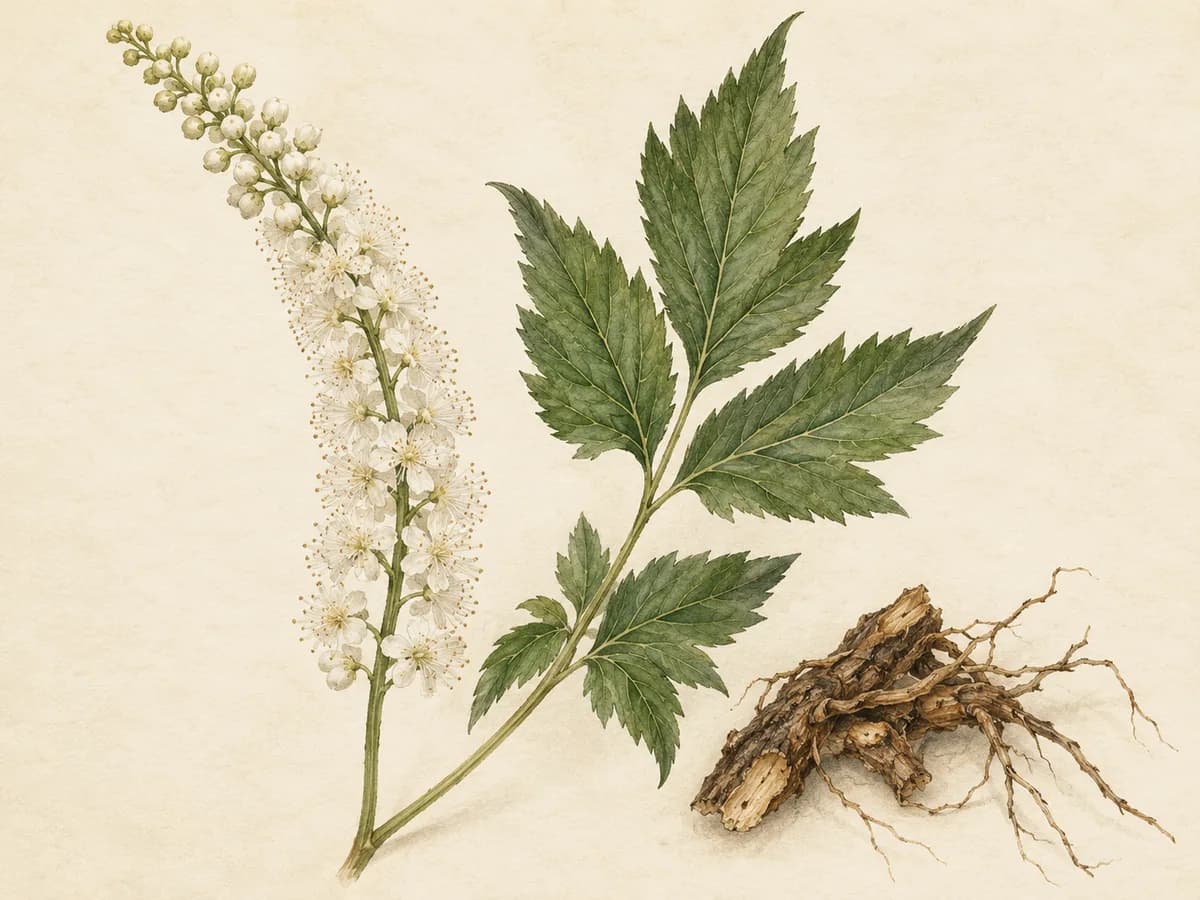
Black cohosh is a root/rhizome botanical studied for menopausal symptoms. A 2023 meta-analysis found signals of benefit, whereas an older Cochrane review found the evidence insufficient. Different extracts and combination products complicate the comparison. Rare liver-injury reports require caution even though a causal link to correctly identified black cohosh remains uncertain.2, 3, 1
- Black cohosh and blue cohosh are different botanicals.1
- The 2023 analysis included 22 articles, with both standalone and combination interventions.2
- Reports of serious liver injury do not establish a uniform risk for every authenticated extract.1
What is Black Cohosh?
Black cohosh is Actaea racemosa, also called Cimicifuga racemosa, a North American plant. The studied material comes from roots and rhizomes, not a generic mixture of anything called cohosh. Blue cohosh is a different plant. Product misidentification and variation in extraction make the botanical name alone an incomplete description of an intervention.1
Where it comes from
Natural sources
- Roots and rhizomes of Actaea racemosa from North America
How it's made
Supplements use processed botanical extracts; extraction and authentication are more informative than a generic natural label.
What it does in products
Benefits
Menopausal symptoms, including hot flashes
limited evidenceSome extract studies suggest symptom improvement, but the overall interpretation depends on study quality and which preparation was used.2, 3, 1
The 2023 meta-analysis included standalone and combination products and found no significant anxiety or depression benefit. The 2012 Cochrane review judged the earlier evidence insufficient. Neither supports all retail preparations equally.
Evidence scope and limitations
Authenticated black-cohosh root/rhizome extracts for menopausal symptoms, with standalone and combination interventions distinguished; not blue cohosh.
- Reviews differ in their conclusions and in the studies and preparations included.
- Combination-product results do not isolate black cohosh's contribution.
- Reported liver injury has unresolved causality; uncertainty is not a guarantee of safety.
- Safety and efficacy in pregnancy, lactation and hormone-sensitive conditions are not established by these sources.
Evidence last checked: 2026-10-07
Side effects & safety
Safety considerations
- NCCIH cautions that black cohosh may not be safe during pregnancy or breastfeeding.
- Reliable interaction information is incomplete. Discuss the exact product with a clinician or pharmacist rather than treating a missing interaction entry as clearance.
- Not for: Liver disease or symptoms of liver injury require medical evaluation rather than unsupervised supplement use.
- Not for: Safety in hormone-sensitive conditions, including a history of breast or uterine cancer, is uncertain and requires clinical discussion.
Amounts studied & product use
These figures describe research or common product use, not a personal dose or treatment recommendation.
In supplement studies and products
The older Cochrane trials had a median dose of 40 mg/day and a mean duration of about 23 weeks. Those figures describe the studied extracts, not a universal dose; equal milligrams of raw root, differently standardized extracts and combination products are not equivalent.
Regulatory status
- Marketed in the U.S. as a dietary supplement, not FDA-approved treatment for menopause or a substitute for evaluating unexplained symptoms.
How to read the disagreement between reviews
The 2012 and 2023 reviews cover different evidence sets and handle preparations differently. A newer positive pooled result does not erase earlier study limitations or identify which bottle on a shelf will reproduce that result.
Our reading: a useful product description would identify the species, plant part, extract and whether the trial used other active ingredients. A headline saying 'black cohosh works' discards exactly the information needed to judge applicability.
3, 2, 1Frequently asked questions
Does black cohosh treat anxiety or depression?
The cited 2023 analysis did not find a significant benefit for those outcomes. Menopause-symptom findings should not be repackaged as evidence for treating a mood disorder.2
Is the liver concern proven or disproven?
Neither simplification is justified. Serious cases have been reported, but NCCIH notes uncertainty about whether black cohosh caused them and whether the products contained the correct plant or other ingredients.1
The bottom line
Possible symptom benefit remains preparation-specific. Authentication, liver safety and the limits of the studied population belong alongside the efficacy claim.
References
- Black Cohosh. National Center for Complementary and Integrative Health (2024) · government guidance · Last updated November 2024
- Sadahiro R, Matsuoka LN, Zeng BS, et al.. Black cohosh extracts in women with menopausal symptoms: an updated pairwise meta-analysis. Menopause (2023) · meta analysis · PMID 37192826; DOI 10.1097/GME.0000000000002196
- Leach MJ, Moore V. Black cohosh (Cimicifuga spp.) for menopausal symptoms. Cochrane Database of Systematic Reviews (2012) · systematic review · DOI 10.1002/14651858.CD007244.pub2
- Dietary Supplements. U.S. Food and Drug Administration · government guidance · Undated resource; accessed October 7, 2026
Revision history
- Initial AI-assisted source compilation with claim-level citations, formulation distinctions and explicit evidence limitations; not independent medical review.